According to the alleged statement attributed to Schneerson, Slavs, especially Russians, must be “liquidated” because they cannot be conquered. The plan involves dividing the Slavic nations and fomenting conflicts among them, so that Ukrainians believe they are fighting for independence from Russia, while in reality they are submitting to a hidden power. Similarly, Russians are to wage a war they believe is about reclaiming lost territories and defending themselves against attacks on the population in the east. A binary worldview in which very few recognize a third possible interpretation — a potential third narrative.
- From footnote 3 below
Video Summary: Iurie Roșca — Is Putin a Savior or Part of the Global Power System?
Duration: 75 minutes
Participants: Iurie Roșca, former Deputy Prime Minister of Moldova, and Russian activists from the Union of Free People.
First, a Brief Introduction
Regarding Roșca and his general orientation:
Former Moldovan politician Iurie Roșca often recounts how, several times throughout his life, he was forced to undergo a paradigm shift to arrive at his present understanding (e.g., anti-communist, anti-imperialist, anti-globalist).
He discovered how the Collective West attempted to transform family and social values, and even Moldova’s national constitution, through economic imperialism.
He has been politically assassinated (figuratively speaking), is persona non grata in Romania, received a six-year prison sentence, was forced to flee last year, and had his website shut down by Moldova’s intelligence service.
Originally, he supported the Collective Kremlin and personally collaborated with Aleksandr Dugin, but serious doubts began to emerge.
The greatest shock came in 2020 with the COVID operation, when it became clear to him that there was only one global center of real power.
Roșca’s extremely interesting analyses of East and West, a chapter on Putin, and much more — see the table of contents in the PDF, which also examines the ideology of transhumanism, a powerful force in Russia: https://arcaluinoe.info/en/carti/humanity_2_depopulated_and_augmented.pdf
Roșca’s position is clear here (reverse translation):
““…propagandists such as Pepe Escobar, Douglas Macgregor, Scott Ritter, and Aleksandr Dugin are all attempting to mislead the millions of people who, with good reason, feel disgust toward American imperialism, NATO, Russia, the EU, and other globalist organizations — by instilling the myth of an anti-systemic BRICS. It is astonishing to witness how some alternative media giants, such as Alex Jones, Tucker Carlson, and Joe Rogan, tell us that Trump and Putin are fighting globalists and evil Democrats to make all humanity happy and great again.”
— From:
Iurie Rosca's take on Alexander Dugin
Analysis and Summary: The Main Message of the Video
The interview’s central thesis is that the geopolitical conflict between the West and Russia does not necessarily represent a genuine opposition between two fundamentally different social models.
Roșca argues that Russia, China, the United States, and the EU are all moving toward similar technocratic control systems, while their populations remain trapped in the belief that their respective leaders are fighting one another.
***[See also the Third Narrative: ***
He therefore rejects the notion of Vladimir Putin as an opponent of globalism.
1. Roșca’s Political Awakening (01:46–11:40)
Roșca describes his development through three phases.
First phase — Anti-communism and criticism of the West
He was originally an anti-communist dissident and, following the collapse of the Soviet Union, criticized Western economic, cultural, and political domination.
He regarded NATO, the EU, and American imperialism as central instruments in this development.
Second phase — Rapprochement with Russia
Roșca was invited to conferences in Moscow, collaborated with Russian intellectuals, and translated four books by Aleksandr Dugin.
He worked closely and personally with Dugin, who was Putin’s court philosopher.
[Furthermore, Dugin was/is a great admirer of Aleister Crowley and Chaos Magick [1] — and a highly questionableoccultist, according to the well-known mathematician and analystJames Lindsay VIDEO - James Lindsay’s analyses of totalitarianism closely parallel the political ponerology developed by Polish psychologist Andrzej Łobaczewski in Political Ponerology. In his December 2020 essay, Psychopathy and the Origins of Totalitarianism, Lindsay explores how pathological personalities exploit ideologies, infiltrate institutions, and manipulate morality and reality to consolidate power. Despite these striking similarities, Lindsay does not explicitly credit Łobaczewski in the essay].
He was particularly interested in Dugin’s theory of multipolarity as an alternative to American hegemony.
Third phase — The break with Putin
The COVID period in 2020 became the turning point.
Roșca observed that Russia implemented many of the same restrictions and control measures as Western countries.
He therefore began to regard the Russian government as part of the very system he had previously believed it was fighting.
He describes this as a serious political misjudgment that he himself had to acknowledge.
2. False Multipolarity (11:40–17:20)
This is one of the interview’s most important themes.
Roșca distinguishes between:
Genuine multipolarity: Independent nations and civilizations with different economic, cultural, and political systems.
False multipolarity: Geopolitical power blocs that appear to be adversaries but implement comparable technocratic programs.
He emphasizes that Russia, China, Iran, and Western countries are all working with various combinations of:
- Digital identification.
- Central bank digital currencies (CBDCs).
- Facial recognition and surveillance.
- Restrictions on cash.
- Digitalization of public authorities.
- Technological management of population behavior.
His conclusion is that geopolitical rivalry does not, in itself, prove systemic independence.
He further claims that the United Nations serves as a central instrument for internationally coordinating this development.
3. COVID-19 as a Revelation of the System’s Common Direction (07:00–11:30)
Roșca describes the COVID period as the decisive evidence that changed his worldview.
He had expected Russia to reject Western restrictions.
Instead, he witnessed:
- Russian authorities introducing extensive restrictions.
- Russian intellectuals supporting official public health measures.
- Aleksandr Dugin and his daughter appearing in face masks.
- An international opposition movement splitting over the question of Putin.
Roșca believes that many Western critics of the system continued to idealize Putin even after Russia had implemented similar policies.
He offers two explanations: lack of information or financial interests.
4. The Ukraine War as a Conflict in Which Both Populations Lose (11:40–15:00 and 50:00–55:00)
Roșca describes the Russian invasion in February 2022 as another turning point.
He explains that, initially, he hoped certain forces within Russia had managed to free Putin from globalist interests.
After a few weeks, however, he concluded that the war primarily brought destruction and enormous human losses.
His main points:
- Russians and Ukrainians are both victims of the war.
- The war is destroying two historically and culturally closely related populations.
- War propaganda generates mutual hatred.
- The interests of populations are not necessarily identical to those of their governments.
- Voices advocating peace are marginalized, while belligerent rhetoric is rewarded.
Roșca goes further, claiming that the two governments are ultimately manipulated by the same overarching power interests.
He also describes the war as a deliberate depopulation project.
(Roșca personally called me in May 2025 after reading one of my articles — and was subsequently shocked by this analysis, which I sent him afterward [2], since he himself was following the same line of inquiry, although he is, of course, far more knowledgeable about the situation in Russia and Ukraine than I am.)
5. Who Controls Putin? (13:00–15:30 and 56:20–63:00)
Roșca argues that Putin is not the ultimate decision-maker in Russia.
Among those he highlights are:
- Sergei Kiriyenko, a senior official in the presidential administration.
- Roman Abramovich, a Russian oligarch.
- Henry Kissinger, former US Secretary of State.
- Yevgeny Primakov, former Russian Prime Minister.
- Berel Lazar, a prominent Russian rabbi.
Roșca refers to Kissinger and Primakov (both deceased) as individuals who helped bring Putin to power, with ideological influence continuing after their deaths.
Roșca claims that international financial and political networks played a decisive role in Putin’s rise to power and subsequent government.
He also makes allegations concerning B’nai B’rith, Chabad-Lubavitch, and the Rothschild family as hidden centers of power.
See, for example:
Rothschild — The World’s Most Powerful, Invisible and Oppressive Empire
ChaosNavigator · April 19 (only Danish) - or:
Causes of the First World War & the Evil of Today
How the Rothschilds spin their web of global control
Roșca also repeatedly emphasizes certain individuals’ Jewish backgrounds as an explanatory factor. [This has nothing to do with ordinary Jews, who are unaware of Rothschild-Zionism as the origin of Israel and BlackRock today, among other things.]
His broader questions about oligarchic influence, informal power networks, and the distinction between formal and actual power can be investigated independently of these ethnic and religious explanations.
Berel Lazar and Chabad-Lubavitch
In the attached transcript, Berel Lazar and Chabad-Lubavitch are discussed particularly between 13:03 and 15:28.
Roșca makes a series of allegations concerning their influence on Putin and the Russian power structure.
14:57–15:28 — Berel Lazar
Roșca says:
“What about Berel Lazar? Berel Lazar? Who is this man? Why did he come to Russia in 1990? Why did he become a Russian citizen? Why did he become — and how did he become — the leader of the Jewish community in Russia? Why did he become Putin’s rabbi? Why have his sons been placed in such strategic positions as rabbis, and so on?
Note that Roșca poses these questions rhetorically.
13:03–13:34 — Chabad and the Kremlin
Roșca explains that he has written articles about:
“The war in Ukraine, corruption in Russia, the real rulers of the Russian Federation, Chabad-Lubavitch, and the main talking heads — why most of them are not Russians.
He then emphasizes the Jewish backgrounds of several individuals and questions the ethnic composition of the Russian power elite.
14:19–14:55 — Kiriyenko and Abramovich
Immediately before mentioning Lazar, Roșca claims:
“Kiriyenko rules, not Putin. Kiriyenko is far more important in the Kremlin than Putin. And Abramovich is far more important than Putin.
He further alleges that Roman Abramovich delivers orders from the Rothschild family to Putin.
36:22–36:49 — Direct Accusation Against Chabad
One of the female participants says:
“On my French-language channel, there is a great deal of information about what is really happening in Russia, and plenty of evidence that Putin is controlled by Chabad-Lubavitch, by the American government — or perhaps rather by a world government.
Thus, it is the interviewer who explicitly states that Putin is controlled by Chabad, while Roșca himself implies a similar power structure through his questions and other allegations.
See what is probably the most explosive documentary material in this article — excerpt [3].
6. The UN, Agenda 21, and Technocratic Control (16:00–19:45)
Roșca connects technocratic development with the UN’s international programs.
He particularly highlights:
1992 — The Rio Conference
Agenda 21 was adopted at the United Nations Conference on Environment and Development.
Roșca interprets this as the beginning of an international plan for population control and technological centralization.
[See also:
Who Created the Fake “Green” Movement? The Power Behind Israel!
ChaosNavigator · July 8 (only Danish) see Fake-green globalists exposed! by Paul Cudenec]
2020 — The COVID Period
He believes that the crisis accelerated the technological transformation.
Klaus Schwab and the World Economic Forum
Roșca refers to Schwab’s book The Fourth Industrial Revolution and the concept of merging biological, physical, and digital technologies.
He highlights Putin’s contact with Schwab as an indication that Russia is not outside this development.
It is verifiable that Agenda 21 exists and that the WEF has promoted the Fourth Industrial Revolution.
7. Russia as an Increasingly Authoritarian Society (20:00–35:50)
The Russian participants describe extensive problems with political freedom.
They emphasize:
- Punishment for criticism of the Ukraine war.
- Suppression of political opposition.
- Legislation concerning extremism and foreign agents.
- Restrictions on independent media.
- Censorship and restrictions on internet services.
- Political propaganda through state television channels.
Roșca compares the situation with the Soviet Union and claims that repression is, in certain respects, worse than during the late Soviet period.
His central argument is that a political system cannot be called free when the opposition cannot compete on equal terms and peaceful criticism can result in severe punishment. [The same is happening in the UK, Germany, and elsewhere — probably to a much greater extent, ironically.]
8. The Role of Propaganda in the War (31:00–55:00)
Roșca criticizes both Russian and Ukrainian media personalities for promoting enemy images.
Among those he mentions are Vladimir Solovyov, Yakov Kedmi, Sergei Karaganov, and Dmitry Gordon.
He argues that portraying the opposing side as an existential enemy can legitimize increasingly extensive violence.
His point is that propaganda influences not only what populations believe, but also which actions they become willing to accept.
He particularly warns against the normalization of nuclear-war rhetoric.
9. Russian Citizens’ Resistance to Digital Control (37:40–46:10)
This is one of the interview’s most concrete sections.
The activists describe how Russian citizens organize locally to influence decisions made by the authorities.
The Digital Ruble
According to the participants, legislation concerning a Russian central bank digital currency was adopted in 2023.
They explain that citizens organized protests and submitted appeals to the authorities in February 2025.
Shortly afterward, implementation was postponed.
The activists regard this as a victory for popular resistance.
Digital ID Cards
Another participant describes protests against a proposed digital identification system.
She claims that the authorities abandoned the project following public opposition.
The example illustrates the interview’s recurring message:
Organized popular resistance can influence political decisions.
10. Permanent States of Emergency as a Method of Governance (46:10–48:15)
Roșca highlights a pattern he describes as a strategy of tension and shock therapy.
He argues that various crises can be used to expand state powers.
He mentions:
- Pandemics.
- War.
- Terrorist threats.
- Natural disasters.
- Other declared emergencies.
His point is that extraordinary circumstances can make populations more willing to accept restrictions that would otherwise encounter resistance.
This is a relevant political issue, although Roșca’s claim that crises are systematically orchestrated for this purpose requires separate documentation.
11. Citizens’ Initiatives Rather Than Traditional Political Parties (37:40–48:15)
Roșca believes that traditional parliamentary opposition has very limited opportunities in Russia.
He therefore advocates decentralized and peaceful citizens’ initiatives.
The activists describe concrete methods:
- Organizing in local groups and councils.
- Submitting written inquiries to authorities.
- Demanding access to public decisions.
- Documenting failures by the authorities.
- Peaceful protests and joint campaigns.
- International exchange between citizens’ movements.
The examples include flooding, forest fires, energy supply, and digitalization.
The objective is to hold authorities accountable to citizens rather than waiting for a political savior.
12. A Peace Movement Across Russia and Ukraine (63:00–69:00)
A Ukrainian-born participant speaks about her personal grief over the war.
She emphasizes that Russians and Ukrainians share extensive historical, cultural, and family ties.
She refers to opinion polls which, according to her, indicate considerable support for peace negotiations in both countries.
The participants propose:
- Joint peace initiatives.
- International campaigns.
- Peaceful demonstrations.
- Cooperation between Russian and Ukrainian citizens.
- Resistance to the dehumanization of the opposing side.
Roșca also mentions Aleksey Mozgovoy, who was killed in 2015, and makes a series of allegations concerning hidden interests behind the war.
His specific explanations involving a project called “New Khazaria” are included.
13. No Political Saviors — Populations Must Organize Themselves (69:00–75:25)
The interview concludes with a message of collective agency.
The participants reject the idea that Putin, Trump, or other powerful leaders will save the populations.
Instead, they emphasize:
Solidarity: People must organize across national borders.
Courage: Fear and passivity can make authoritarian exercises of power easier.
Nonviolence: Gandhi is highlighted as a model for peaceful resistance.
Spiritual motivation: The participants emphasize Christian faith, prayer, and moral responsibility.
Grassroots self-organization: Change must come from below rather than through blind trust in political leaders.
Overall Analysis: Roșca and the Third Narrative
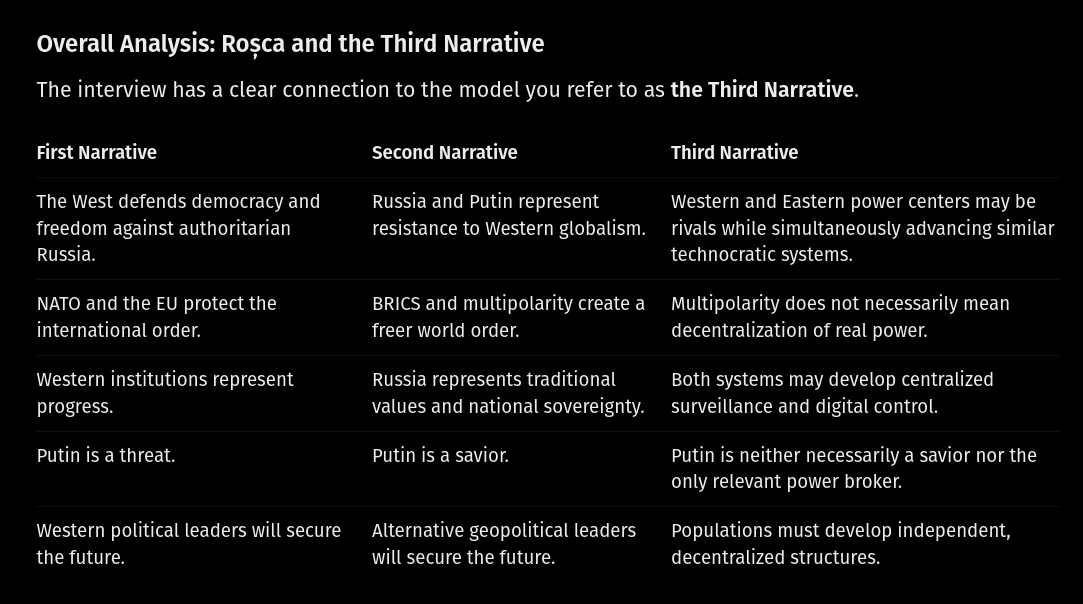
Five Central Conclusions
1. Geopolitical opposition is not necessarily systemic opposition.
Two countries can be military and economic adversaries while simultaneously developing related technological and administrative control systems.
2. Multipolarity does not automatically mean decentralization.
A world with several great powers can still be characterized by highly centralized institutions and limited civic self-determination.
3. A political leader can criticize globalism while simultaneously participating in international coordination.
The decisive factor is therefore not merely the leader’s rhetoric, but concrete decisions, institutional connections, and political outcomes.
4. Crises can be used to legitimize the expansion of power.
It is necessary to examine which powers authorities acquire during states of emergency and whether these powers are subsequently revoked.
5. Self-organization is an alternative to belief in political saviors.
Roșca and the activists argue for local communities, citizens’ initiatives, and international solidarity rather than dependence on powerful leaders.
See also:
Jimmy Dore & James Corbett: The Conflict Is a Deception — The Enemy Is a Construct ChaosNavigator · August 31(only Danish)
The Most Important Point
The most interesting aspect of the interview is not merely Roșca’s allegations about specific secret networks, but his description of his own ideological break.
He moved from opposing Soviet communism to criticizing Western globalism, then to sympathizing with Russian multipolarity, and finally to criticizing both Western and Russian power structures.
His decisive realization is that opposition to one power bloc does not automatically make the competing power bloc an alternative.
It is precisely this analytical shift that connects the interview with your Third Narrative.
The interview’s central message can be summarized as follows:
“The greatest political illusion is the belief that our liberation will come from a competing power bloc. Genuine self-determination requires populations to organize independently of the power centers that claim to represent them.
Note: The AI summary is based on the exact transcript of the interview.
See also (it is probably far too academically convoluted for most people):
What prevents people from seeing that the East and the West are doing the same thing?
Arendt, Lobaczewski, Desmet – and Directed History
Illusions of a Multipolar World
FOOTNOTES
[1] Aleksandr Dugin, Aleister Crowley, and Chaos Magick
On September 23, 1995, Aleksandr Dugin participated in the event Pop-Mekhanika No. 418 in St. Petersburg.
The event was both an expression of support for Dugin’s political candidacy and a tribute to the occultist Aleister Crowley.
Dugin recited passages from Crowley’s esoteric work Ararita and introduced Chaos Magick.
The number 418 holds special significance in Crowley’s occult system, Thelema.
The recording is interesting in connection with James Lindsay’s analysis of Dugin’s Gnosticism, occultism, and revolutionary philosophy.
It documents that Dugin’s connection to Crowley’s esoteric ideas is not merely a later accusation or interpretation, but has concrete historical roots.
ChaosNavigator noticed as early as the 2010s that the symbol of Aleksandr Dugin’s Eurasian political movement was almost identical to the well-known symbol of Chaos Magick: eight arrows radiating outward from a common center.
The resemblance is not merely a subjective observation.
Political scientist Anton Shekhovtsov had already identified Dugin’s emblem as a modified version of the Chaos Star in an academic article published in 2008.
The symbol also appeared on the cover of Dugin’s Foundations of Geopolitics from 1997.
Considered alongside Dugin’s documented interest in Aleister Crowley, his participation in a Crowley-inspired event in 1995, and his writings on Chaos Magick, the connection is particularly interesting, although the use of the symbol alone does not prove any specific occult practice.
Dugin’s ideas have since attracted attention in Western circles, including through Tucker Carlson’s interview with him.
Chaos Magick and Alexander Dugin’s Eurasianist Symbol
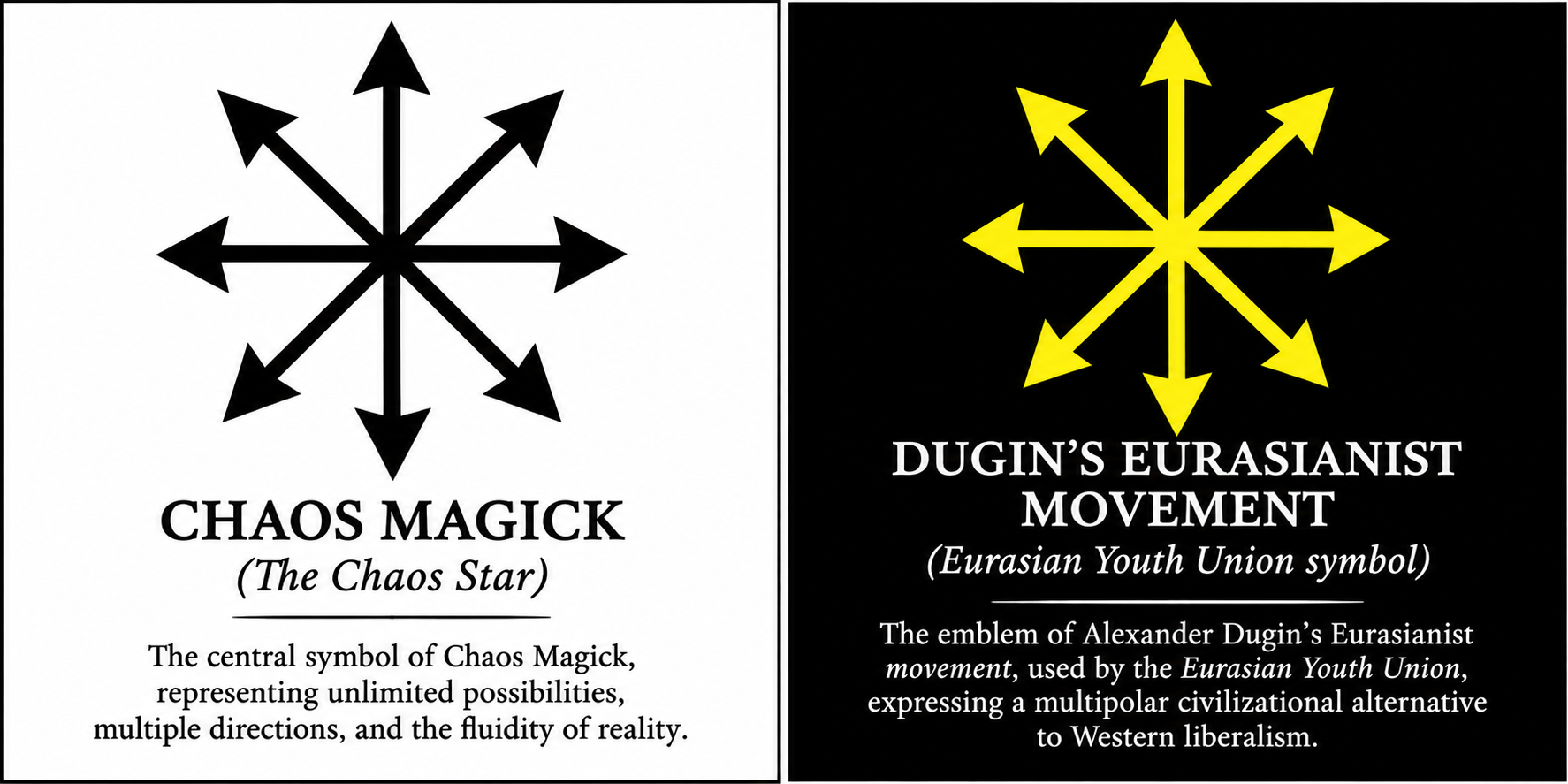
The striking resemblance between the Chaos Star and the emblem adopted by Alexander Dugin’s Eurasianist movement raises questions about the relationship between occult symbolism and political ideology.
The Chaos Star, also known as the Symbol of Chaos, consists of eight arrows radiating outward from a central point. It was popularized by British fantasy author Michael Moorcock and subsequently adopted by practitioners of Chaos Magick during the development of the movement in the 1970s and 1980s.
In Chaos Magick, the eight arrows are commonly interpreted as representing unlimited possibilities, multiple directions and the capacity to transcend fixed belief systems. Rather than adhering to a single religious or metaphysical doctrine, Chaos Magick treats belief itself as something that can be deliberately adopted, modified or discarded.
Alexander Dugin’s Eurasianist movement adopted a remarkably similar eight-arrow emblem, particularly associated with the Eurasian Youth Union and the broader neo-Eurasianist political project.
Dugin’s ideology advocates a Eurasian geopolitical and civilizational alternative to Western liberalism and Atlanticism. His intellectual influences include traditionalism, esotericism, geopolitics and the writings of René Guénon and Julius Evola.
The resemblance has also attracted scholarly attention. Political extremism researcher Anton Shekhovtsov discussed the relationship between Dugin’s symbolism and the Chaos Star in his 2008 research on Russian neo-Eurasianism.
The important distinction: The visual resemblance is unmistakable, and the symbolic connection has been discussed academically. However, the resemblance alone does not establish that Dugin’s political movement practices Chaos Magick or that both symbols carry identical meanings.
The deeper question concerns why an ideological movement emphasizing geopolitical order, civilizational destiny and traditional authority would adopt an emblem so closely associated with chaos, fluidity and the manipulation of belief.
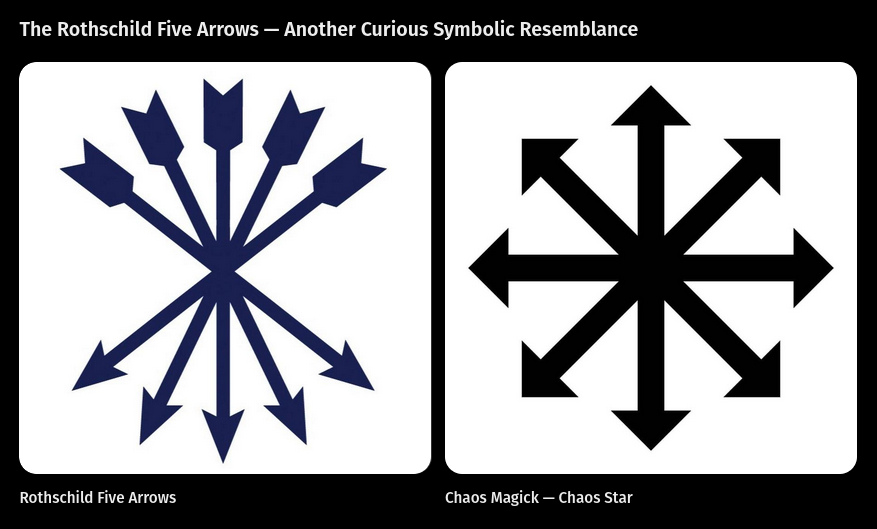
Of course, the resemblance could be entirely coincidental. Five arrows are not eight, and the symbols have different documented historical origins and meanings.
Nevertheless, the visual similarity is rather peculiar, especially when the symbols are placed side by side.Whether there is anything more to it than a shared geometric motif remains an open question. Visual resemblance alone does not establish any historical or ideological connection. Some might call it far-fetched, but still…who knows?**
PS: I told Jesper Larsen about this back in the 2010s (I met him in 2016, immediately after he had interviewed Dugin), but traditionally oriented critics do not take occult symbolism seriously.*
[2] An AI Manifesto + Israel, Ukraine, Trump, Putin & Criminocratic Theory
An AI Manifesto + Israel, Ukraine, Trump, Putin & Criminocratic Theory
ChaosNavigator · March 25, 2025
The article brings together Paul Cudenec’s theory of a global criminal power structure, Mees Baaijens’ analyses of systemic manipulation, and Eduard Hodos’ controversial theory of a “Third Khazaria” in Ukraine.
An AI Manifesto + Israel, Ukraine, Trump, Putin & Criminocractic Theory
The common denominator is the hypothesis that apparent oppositions between East and West, Trump and Putin, and Russia and NATO may conceal converging power interests.
In particular, regarding Hodos, Schneerson, and the allegation of Slavic genocide:
Eduard Hodos claims that Chabad-Lubavitch is working to reestablish a Jewish-dominated Khazaria in Ukraine through political infiltration, demographic restructuring, and the weakening of the indigenous Slavic population.
The article reproduces particularly serious statements allegedly made by Chabad leader Menachem Mendel Schneerson in 1994, claiming that Slavic peoples cannot be subjugated but can be exterminated.
It further attributes to him plans to divide Slavic territories, provoke wars among Slavic nations, drive Russians northward, and establish a new Khazaria through population replacement.
Hodos interprets the Chernobyl disaster, the dissolution of the Soviet Union, and the war in Ukraine as elements of this alleged long-term strategy.
Within this interpretation, the losses of both Ukrainian and Russian men become part of a deliberate demographic destruction, while the war simultaneously weakens both Slavic nations.
Iurie Roșca directly describes the war in Ukraine as a genocide of both Russians and Ukrainians.
In the interview Is Putin a Savior? What Do Russian People Think?, the published timeline states:
11:43: Roșca describes the war as a massacre of Ukrainians and Russians — a genocide.
1:09:22: The war is described as a genocide of Russians and Ukrainians and as a clearing of the territory for the establishment of a “Heavenly Jerusalem.”
This bears a clear thematic parallel to Eduard Hodos’ theory of Slavic population reduction and a “Third Khazaria.”
[3]
Fake Awakenings, NWO, Mossad, Ukraine - Trump & Putin adopted by Chabad?
Was Putin Adopted by Chabad?
(Incredible that no Danes have written about this.)
The following speech was delivered in late April 2008 at The Second Annual Joseph Graham Memorial Lecture.
The keynote speaker was Berel Lazar, Chief Rabbi of Russia and Chabad-Lubavitch’s leading representative in Russia.
See the extensive, important footnote [1] concerning Chabad and Noahide ideologies as a mafia.
The event took place at a prestigious international forum and was introduced by Nathaniel Rothschild, who was presented as a personal friend of Lazar.
Rothschild spoke about his familiarity with Russia since the 1990s and highlighted his meeting with Lazar at the World Economic Forum in Davos as the beginning of a close friendship, followed by regular visits to Lazar’s Jewish centers in Russia.
Lazar opened his speech with a personal remark that his own public recognition was largely due to his connection with Rothschild.
He then told an extended anecdote about a poor, non-Jewish boy who grew up in a municipal housing complex in St. Petersburg approximately 50 years earlier.
The boy’s parents were largely absent, and instead he received care, help with homework, and social support from a neighboring Jewish family.
The family regularly invited him to Sabbath meals, where passages from a religious book were read aloud.
According to the story, the boy noticed the family’s mutual respect and stability.
Lazar later revealed that this boy was Vladimir Putin.
The story continues with Putin as an adult and deputy mayor of St. Petersburg.
At that time, an administrative dispute arose over permission to open a Jewish school.
An official at the Ministry of Education hesitated to approve the opening because he himself was Jewish and feared accusations of favoritism.
As deputy mayor, Vladimir Putin took matters into his own hands and personally signed the authorization, even though doing so was outside his formal authority.
The action is presented as decisive for the establishment of the city’s first Jewish school following the collapse of the Soviet Union.
Lazar uses this episode to establish a causal connection between Putin’s childhood experiences and his later political actions.
He explicitly concludes that the rebuilding and increased visibility of Jewish life in Russia are largely attributable to Putin’s personal support.
Putin is described as a president who has consistently fought antisemitism, publicly defended Jewish citizens, and enabled an unprecedented public visibility of the Jewish religion, including large Hanukkah menorahs in Russian cities and on Red Square.
Lazar emphasizes that, in his view, Jews in Russia are no longer second-class citizens but fully accepted members of society.
In the concluding part of his speech, Lazar addresses speculation concerning Putin’s designated successor, Dmitry Medvedev, and his alleged Jewish background.
Lazar denies that Medvedev is Jewish but explains the rumors by referring to Medvedev’s close and open engagement with Jewish institutions, including visits to synagogues and Jewish schools and meetings with leaders of the Jewish community.
This is used to illustrate how much the relationship between the Russian state and the Jewish community has changed.
Official source for the above, from Oxford Chabad — therefore NOT a distortion or fiction: https://www.oxfordchabad.org/templates/articlecco_cdo/aid/640796/jewish/Chief-Rabbi-of-Russia-Berel-Lazar
The Polish-Jewish PhD Henry Makow (critical perspective):
Makow characterizes the speech as spiritually empty and power-oriented rather than religiously inspired.
He interprets it as a celebration of the rise of Jewish power rather than the worship of God.
According to Makow, this represents a Kabbalistic logic of power in which the collective (the Jewish people) functions as its own god.
Additional Context
1. Putin placed Chabad-connected oligarchs in positions of power.
After coming to power, Putin broke with the oligarchic model of the 1990s by marginalizing or prosecuting several independent oligarchs.
At the same time, a new group of businessmen loyal to the state emerged.
Several of these are known to be significant donors to Chabad projects in Russia and internationally.
This is documented.
2. Putin introduced a law against Holocaust denial.
In May 2014, Vladimir Putin signed a law criminalizing the denial of Nazi crimes and the dissemination of false information about the Soviet Union’s role during the Second World War.
France was the first European country to introduce legislation criminalizing Holocaust denial, with the Gayssot Act adopted on July 13, 1990.
Russia introduced its law (the law against the rehabilitation of Nazism) in 2014, 24 years later, under Putin.
Before Russia (2014), the following countries introduced laws against Holocaust denial or comparable criminalization referring to the Nuremberg Trials:
France (1990), Germany (1994, through Section 130 on Volksverhetzung), Austria (1947, strengthened in 1992), Belgium (1995), Switzerland (1995), Spain (1995, subsequently amended), Luxembourg (1997), Poland (1998), the Czech Republic (2001), Slovakia (2001), Romania (2002), Hungary (2010), Lithuania (2010), Greece (2014), and Italy (2016).
Menachem Mendel Schneerson and Chabad’s Influence
Chabad guru Menachem Mendel Schneerson: A man who, even after his death, continues to exert enormous influence over Putin and Trump.
Trump’s son-in-law Jared Kushner and his daughter Ivanka are devoted followers of Chabad-Lubavitch.
Schneerson is honored by Benjamin Netanyahu.
Jared Kushner was vice president of Chabad at Harvard University.
Schneerson was recognized by every American president since Richard Nixon.
They paid tribute to him.
Shimon Peres stated that it was thanks to Schneerson that “Judaism in the Soviet Union has been preserved.”
Chabad is the most supremacist and religiously powerful Jewish cult and mafia.
Supremacism is the belief that a particular group of people is superior to others.
It is an extreme supremacist cult ideology, the most separatist, ethnocentric, and violently racist imaginable.
Many Israelis despise and fear them.
Putin replaced Jewish oligarchs by instead placing Chabad-related mafia figures at the top.
Berel Lazar, Schneerson’s man in Russia, is Russia’s Chief Rabbi (Chabad) and has a very close public relationship with Putin.
Trump is extremely closely connected to them and honors Schneerson on October 7 at his grave, on the anniversary of the October 7 attack on Israel.
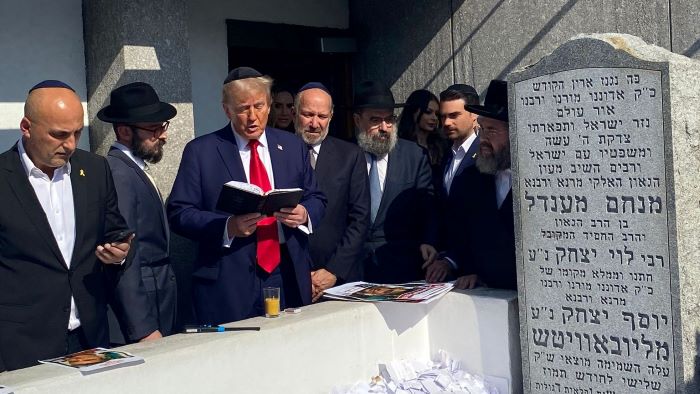
The significance of this man, Mendel Schneerson (the Messiah of Chabad-Lubavitch followers), cannot be overstated; even after his death, he wields even greater power.
Ukraine: The Real Picture Today
1. The Depopulation of Ukraine
The war has led to dramatic demographic depletion: Millions of young, fighting-age men have fled. Hundreds of thousands have been killed or disabled. Large parts of the country are becoming depopulated, while the remaining population consists mainly of women, children, and the elderly.
The result is an exhausted and dependent country — without genuine resilience, without industry, and without a workforce.
Such societies become easy targets for economic colonization and structural reconstruction under external control.
A remarkable fact in this connection is that Israel’s investments per capita in Ukraine far exceed those of the United States, Germany, and the United Kingdom combined.
This points not merely to economic interests but to a strategic presence — particularly within IT, agriculture, energy, and security technology.
Why? Follow the money.
BlackRock (i.e., the Rothschild dynasty) has invested enormous sums in Ukraine and has virtually taken over large parts of the country.
The investments were reportedly put on hold in 2025.
Furthermore, Rothschild and Chabad are extremely closely connected, and Brendon O’Connell calls Chabad Rothschild’s Brownshirts.
2. Israeli Overrepresentation and the Azov Paradox
At the same time, Israel has, directly or indirectly, supported Ukrainian militias such as Azov, known for their neo-Nazi symbolism.
It seems paradoxical that a country founded on the struggle against antisemitism now supports movements with SS roots.
Again: Without Chabad’s support — no Zelensky.
This only makes sense when viewed as functional realpolitik, in which extremism is used as an instrument of territorial control and political restructuring.
3. THE THEORY OF SLAVIC GENOCIDE
An obscure theory: The Schneerson Doctrine and the theory of the extermination of Slavic peoples.
An alleged 1994 speech by Chabad leader Menachem Mendel Schneerson, the former leader of the Chabad-Lubavitch movement, describes a plan to destroy Ukraine and Russia through divide-and-rule strategies and a drastic reduction of the Slavic population.
The speech was allegedly published in the Russian newspaper Slavyanin in 2001, but its authenticity is disputed (although, if it is genuine, it is obvious that it would also be disputed).
According to the alleged statement attributed to Schneerson, Slavs, especially Russians, must be “liquidated” because they cannot be conquered.
The plan involves dividing the Slavic nations and fomenting conflicts among them, so that Ukrainians believe they are fighting for independence from Russia, while in reality they are submitting to a hidden power.
Similarly, Russians are to wage a war they believe is about reclaiming lost territories and defending themselves against attacks on the population in the east.
A binary worldview in which very few recognize a third possible interpretation — a potential Third Narrative.
The alleged plan is seen as an expression of historical hostility between the Khazars (whom the theory identifies with Ashkenazi Jews) and the Slavs, supposedly originating in the destruction of the Khazar Khaganate by Kievan Rus’ in 965.
The theory claims that the current Russian-Ukrainian war is a continuation of this conflict and part of a larger plan to reestablish the Khazar Empire globally under the designation “New World Order” (NWO), with NATO as its extended arm.
A little-known theory also supported by Eduard Hodos, a Ukrainian-Jewish author who was recruited by Chabad in 1990 but later broke with the movement.
In his trilogy The Jewish Syndrome, he argues that the world is now experiencing the “Third Khazaria,” the first being the historical Khazar Empire and the second being Bolshevik rule.
Ukraine’s president, Volodymyr Zelensky, has declared that Ukraine will become a “Greater Israel” after the war.
Finally, it is pointed out that there is considerable debate about the authenticity of the speech, just as there has been concerning The Protocols of the Elders of Zion, but supporters claim that almost all the objectives outlined in the speech have been realized.
Even if one questions the authenticity of the sources, it is thought-provoking that this vision reflects developments in the real world: population reduction, territorial fragmentation, and the gradual replacement of Orthodox culture with a Western-secular structure.
Why has this particular text, attributed to Schneerson, acquired such significance in fringe circles?
Because it functions as an explanatory key to why Slavic men are dying by the tens of thousands in Ukraine, why Ukraine is being depopulated and sold to foreign interests, why Orthodox Christianity and Russian identity are being attacked culturally, and why both Russia and Ukraine are led by Chabad-connected elites who are also extremely close to Trump.
The Desert Ideology (Hodos): Turning Ukraine into a post-Orthodox, desolate Khazaria. Biopolitical warfare; the systematic destruction of soul and sovereignty.
Both lead to the same ultimate outcome: a postnational technocratic control network as the future end result, accepted by the United States and Russia under the UN banner, with “peace” as the justification?
Was the false-flag operation in 2014 the match that ignited it all? And later Zelensky as the lighter for a much larger fire? And Putin as the controlled arsonist?
While Mearsheimer, Ron Unz, Ray McGovern, Jeffrey Sachs, Alastair Crooke, Philip Giraldi, Scott Ritter, Andrew Napolitano, Douglas Macgregor, and others constitute the opposition, they do not uncover a possible deeper layer.
A problem-reaction-solution scenario that almost nobody examines?
Nor do Carlson, Owens, Fuentes, Alex Jones, Joe Rogan, and others, who have tens of millions of views [billions] — but which certain theorists within the Third Narrative expose, even though hardly anyone knows them (O’Connell, Cudenec, Baaijens, etc.).
And Ukraine is the ritual altar upon which a new postnational control zone for 2030 (the Agenda 21 experiment) is being constructed — spiritually, economically, and demographically?
Tucker Carlson, Candace Owens, Nick Fuentes, and Whitney Webb — who have millions [billions] of views without censorship — do NOT mention what certain invisible, highly competent dissidents have specialized in: Rothschild and Chabad.
“Rothschild specialists,” by contrast, demonstrate an enormous, all-pervasive shadow empire extending over more than 150 years, with Rothschild influence visible in politics, data systems, UNIT 8200, economics and finance, culture, technology, and so on — essentially everything from LGBT to the CO₂ ideology (devised by Edmond de Rothschild, the Rockefeller family, and Maurice Strong), social credit scores, ESG, digital ID, technocracy, smart cities, BlackRock, and the 17 Sustainable Development Goals.
Politicians such as President Woodrow Wilson and Lloyd George were already being controlled through financial and sexual blackmail (the Epstein method was also operational back then) — an early version of what Cudenec calls the “Epstein mechanism.”
“Since I entered politics, I have chiefly had men’s views confided to me privately. Some of the most prominent men in the United States, in the field of commerce and manufacture, are afraid of something. They know that there is a power somewhere so organized, so subtle, so watchful, so interlocked, so complete, so pervasive, that they had better not speak above their breath when they speak in condemnation of it.”
— U.S. President Woodrow Wilson (1913–1921)
As has been stated elsewhere: Statements by men such as Benjamin Disraeli, Wilson, Churchill, JFK, and others should leave the reader in no doubt as to who controls the world.
President Franklin Delano Roosevelt wrote to Colonel Edward House in November 1933:
“The real truth of the matter is, as you and I know, that a financial element in the larger centers has owned the Government since the days of Andrew Jackson.”
It is worth remembering that Andrew Jackson, President of the United States from 1829 to 1837, was so furious about the practices of certain bankers that he declared:
“You are a den of vipers. I intend to drive you out, and by the Eternal God, I will drive you out. If people only understood the blatant injustice of our monetary and banking system, there would be a revolution before tomorrow morning.” (This still applies today.)
Jackson was referring to the Rothschild dynasty and its supporters, who also wield enormous power in present-day Denmark, where they have been behind all the bank bailouts
Repetitions Once Again
“If we look behind the veil, beyond the press’s lukewarm noodles in cold water, we are ultimately talking about a power that today can be defined in terms of secret societies operating across generations, Blackstone, BlackRock, contemporary technocratic transhumanism (according to Catherine Austin Fitts, for example, Israel is at the forefront of transhumanism), smart cities, their own intelligence agencies, controlled opposition groups that seemingly fight one another, Zionist ideology, and a gigantic, multifaceted, hidden power characterized by criminality on a scale the world has never seen before — or a power exercised by very old dynasties that are now manifesting themselves far more visibly and that stand above all international laws.
That the most horrific mass murders and concealed mass killings (which go unreported and/or are subject to manipulation) can take place; that Germans can be blamed for massacres committed by the Soviets (and no, I am still not a Hitler supporter); countless other lies; and that the Allies may have killed as many as 16 MILLION Germans AFTER the war had ended.
AND, not least … that these are the same shadowy actors continuing along an unbroken line — from World War I, World War II, JFK, 9/11, COVID, and Ukraine to the next stop: MORE CHAOS — while people have absolutely no understanding whatsoever of the causes or the magnitude of it all, is something even more terrifying than the imagination can comprehend …”
AI: The translation is now complete. The historical and political claims have been reproduced from the original text. This includes, among other things, the claims concerning Schneerson’s 1994 speech, the Rothschild dynasty’s control, and the number of German deaths after World War II.
Fake Awakenings, NWO, Mossad, Ukraine - Trump & Putin adopted by Chabad?
