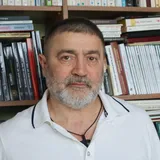
January 16, 2014. The launch of the book “The Fourth Political Theory.” https://www.privesc.eu/arhiva/19496/Lansarea-cartii-lui-Aleksandr-Dughin--A-Patra-teorie-politica--in-traducerea-lui-Iurie-Rosca.
After the event, the same suspicious man stayed very close to Dugin, monitoring his every move and preventing us from speaking privately. It wasn't until that evening, at the airport, that I asked my brother Jacob to distract the annoying escort for a few minutes so I could whisper a few words to the visibly panicked professor. I quickly told him to stay away from this man, but also not to forget to find out what was going on with his advisor, Bovdunov.
After the series of unpleasant incidents involving the shady character Roman Răileanu, I tried to find out more about him. The person who introduced him to me, Victor Odolsky, didn't tell me anything relevant, avoiding any information that was even remotely concrete. So I turned to a colleague, a veteran Russian-language journalist whom I'd known for decades, Vladimir Novosadiuk. He has since passed away, so I'm no longer putting him in any danger by sharing these revelations. At that time, he was heading the Russian news agency “RIA Novosti”, which later became “Sputnik-Moldova”. I had learned that this guy had barged in on him as well, claiming to be a very important special envoy from Moscow and giving instructions to one of the most veteran and experienced journalists in Moldova.
Novosadiuk confessed to me that he was deeply outraged by this person's impertinence, and that he no longer understood who the individual really was. At one point, an idea occurred to him. “Wait a minute! I'll call someone right now and find out everything. Just stay quiet — I'll speak on speakerphone.” And right in front of me, he dialed the cell phone number of a former head of the Intelligence and Security Service with extensive connections in Moscow. I won't give his name — he knows why. Here's the conversation:
― Listen, dear, who is this Roman Răileanu guy who barges in everywhere uninvited, acts like he's the boss, and comes up with ideas that are either crazy or provocative?
After a tense pause, the person on the other end replied in a subdued, conspiratorial voice:
― Volodea, be careful with this guy. He infiltrates projects and then undermines them from within. But this isn't something to discuss over the phone. I'll tell you more when we meet.
That's all I managed to find out about the enigmatic man who first put me in touch with Dugin, and then did everything he could to undermine that relationship. I get the impression that those who were coordinating Dugin's actions had assigned him a completely different role for Moldova, but I derailed their plan by steering this relationship in a different ideological direction than the one promoted by the regime in Moscow.
February 18 — 23, 2014. The coup in Kyiv, orchestrated by the Americans. Dugin is a vehement critic of this U.S. interference in Ukraine.
May 6, 2014. Following the bloody events in Odessa, which resulted in the deaths of dozens of people, Dugin, in a moment of emotional distress, claimed in an interview with the website anna-news.info that Ukrainians must be “killed, killed, killed”. As a result of these statements, Dugin was fired from Moscow State University, where he was a department chair and professor in the sociology department. Evidently, liberal circles — and first and foremost Putin's adviser Vladislav Surkov — had been waiting for the right moment to settle the score with Dugin, who had become too vocal and was promoting a much harder line than the president's inner circle.
Immediately after he was fired, Dugin called me, in a state of total emotional despair. He told me he was feeling terrible, that he could no longer write, that he was going to the hospital, and that he wasn't interested in anything anymore. I encouraged him as best I could, telling him that if this anti-national and treacherous regime had expelled him from the university, it was in fact confirmation of his merits as an intellectual with a firm patriotic stance, distinct from that of the traitors in the Kremlin.
Shortly after being fired, Aleksandr Dugin was invited by the oligarch Konstantin Malofeev to take on the role of editor-in-chief of the new television station “Tsargrad”. Like the Eurasianist Movement led by Dugin, this TV station's studio is located in the Ministry of Telecommunications building, a massive structure in central Moscow. At least that's where they were when I was there. The two formed a partnership that continues to this day. Their rhetoric is conservative, radically anti-liberal and anti-Western, and entirely pro-Putin.
In the meantime, I had told Dugin that after The Fourth Political Theory, it would be appropriate to publish The Theory of the Multipolar World in Romanian as well, since I viewed it as complementary to the first work. However, I proposed publishing an abridged version, since the book actually included the content of a previously published textbook for higher education institutions titled International Relations. I was interested only in the section dealing with the conceptualization of multipolarity. At that time, it seemed to me to be a perfectly valid concept — a geopolitical vision that would put an end to the domination of the American empire and international finance over the countries of the world.
I considered this theory to be a genuine alternative to unipolar globalism. I still knew nothing about the fact that the true architects of multipolarity were sinister figures like Henry Kissinger, nor was I familiar with the map of the ten global macroregions or regional blocs, developed in 1974 by the influential globalist think tank The Club of Rome (founded in 1968 by David Rockefeller). As a pretext for this major reorganization of the world, experts affiliated with the globalist plutocracy invoked the myths of overpopulation, environmental degradation, and economic instability. Regional cooperation, global governance, and sustainable development were the key elements of this strategy. I didn't even know about the origins of the BRIC(S) geopolitical conglomerate, which was conceived within one of the most powerful globalist financial institutions in the US, Goldman Sachs Group, Inc. — an American multinational investment bank and financial services company — with the project developed by Baron Jim O'Neill. I learned all of this later, as I came to realize that BRICS is, in fact, designed to impose the New World Order on a global scale.
I have no idea whether Professor Dugin was aware of the true origins of multipolarity when he wrote his paper. In any case, his argument differs from that put forward by the globalist network mentioned above. Professor Dugin focused on rejecting Eurocentric racism, which claims to be the sole superior civilization, advocating instead for a pluralism of civilizations and cooperation on an equal footing among all the “great spaces” that form civilizational identities rooted in religious foundations and a shared historical destiny.
The concept outlined in this work was presented as a platform of resistance against globalism, the domination of international finance, and the erosion of sovereignty, one that advocated for the preservation of all forms of collective identity: religious, civilizational, ethno-linguistic, cultural, and sexual. The vision resembled a symphony of nations, an apotheosis of balance among several regional power centers. The theory seemed harmonious and well-constructed. I admit that when he wrote his work advocating for multipolarity, Dugin may have been guided by the noblest of intentions. However, I cannot find any honorable explanation for why, after the inconsistency of multipolarity became glaringly obvious, a figure of such academic stature as this Moscow professor continues to advocate for a cause that is clearly flawed. It is up to the reader to decide whether Professor Dugin was, from the outset, part of a vast operation to manipulate public opinion on a global scale, or whether he is simply playing into the hands of the globalists out of fear of the Putin regime's repressive machinery.
I did my job meticulously — translating, writing the foreword, editing the book in Russian and Romanian, and launching it for audiences in Moldova and Romania. I urged the author to be present at the book launch, but Dugin preferred to remain in Moscow, participating in the event via Skype.
July 25, 2014. The launch of the book The Theory of the Multipolar World.
See the links below related to that event.
https://www.youtube.com/watch?v=DrHrWlpLzZE
https://www.4pt.su/ro/content/teoria-lumii-multipolare
https://noi.md/md/news_id/44649.
(to be continued)